← Back to archive

Topic

Asset allocation

Every InvestIQ Asia story tagged Asset allocation. Subscribe below to get the latest intelligence by email.

Pension ambitions, different mandates

Analysis

16 Oct 2026

Pension ambitions, different mandates

Thailand’s proposed overseas expansion, Singapore’s planned CPF life-cycle scheme and the contrasting mandates of Japan’s GPIF and Korea’s NPS show why regional pension opportunities cannot be read from allocation appetite alone.


Korea keeps the 70% risky-asset ceiling in play for retirement pensions

Asset Owners

5 Oct 2026

Korea keeps the 70% risky-asset ceiling in play for retirement pensions

South Korean authorities are leaning toward retaining the 70 per cent cap on risky assets in retirement pensions. Market volatility has slowed a reform push that had aimed to give savers more room. For managers, the near-term product and allocation story stays inside the existing framework.

APAC HNW anxiety is high. Comprehensive asset allocation is still rare.

Private Wealth

2 Oct 2026

APAC HNW anxiety is high. Comprehensive asset allocation is still rare.

Lombard Odier’s regional work with more than 390 high-net-worth individuals across eight Asia-Pacific markets finds only about one in five guided by a comprehensive asset allocation strategy, even as more than half express deep concern about market conditions. Confidence in portfolio fitness remains high. Structure is the gap.

BoJ’s pace debate turns Japan’s domestic bond story from politics into relative value.

Opinion

2 Oct 2026

BoJ’s pace debate turns Japan’s domestic bond story from politics into relative value.

The Bank of Japan’s Summary of Opinions from the September meeting, released around 1 October, shows board members debating a faster path of normalisation after the policy rate reached 1.25 per cent, the highest since 1995. For Japanese asset owners the practical question is no longer whether domestic bonds exist as an option. It is whether rising JGB yields and a more active BoJ make home-market fixed income competitive enough to matter inside existing allocation bands.

This Week in Asia: Rates, bands and where capital is actually moving

Analysis

2 Oct 2026

This Week in Asia: Rates, bands and where capital is actually moving

From Tokyo’s policy calendar to private-market under-allocation and another round of private-bank hiring, the week ending 2 October left a clear message for CIOs and heads of allocation. Japan is again a rates-and-governance story, Asia private markets remain structurally under-owned relative to GDP weight, and franchise building in private wealth has not paused.

Private credit is still wanted. The easy allocation phase is over.

Opinion

29 Sep 2026

Private credit is still wanted. The easy allocation phase is over.

Global asset-owner surveys still show net positive intentions for private credit, but the intensity has cooled from last year’s peak as valuations and selectivity move up the agenda. In Asia, institutional capital continues to build dedicated Asia private-credit capacity even while global programmes become more disciplined. The investment question is underwriting quality, not whether the asset class remains open.

Infrastructure is back at the top of the global asset-owner list. Cash is the swing factor.

Asset Owners

25 Sep 2026

Infrastructure is back at the top of the global asset-owner list. Cash is the swing factor.

The Marsh Global Asset Owner Barometer 2026, covering 430 owners with about US$5.8 trillion in assets, finds infrastructure the strongest net allocation intention for the coming year. Inflation-linked assets and emerging-market equities follow. Cash has flipped from net reduction plans to a clear net increase, restoring optionality after a year of tighter liquidity preferences.

NPS is opening an India government-bond channel. The story is access, not a printed weight.

Asset Owners

23 Sep 2026

NPS is opening an India government-bond channel. The story is access, not a printed weight.

Korea’s National Pension Service is seeking a licence to invest in Indian government securities under SEBI’s lighter compliance route for low-risk foreign investors such as pensions and sovereign funds. Public reporting describes the application as advanced and among the first from a large global pension under that window. A dedicated G-sec channel would sit beside existing India equity exposure via offshore funds.

NZ Super’s year was strong. The allocation question is still geographic risk.

Asset Owners

22 Sep 2026

NZ Super’s year was strong. The allocation question is still geographic risk.

The New Zealand Superannuation Fund reported a 14.2 per cent return for the year to 30 June 2026. Public coverage of the result noted a substantial equity weight and an underweight to US equities during a period when global equity leadership was concentrated. For other asset owners, the lesson is reference-portfolio design, not a single year’s number.

NPS changes CIO with the domestic book still heavy

Asset Owners

18 Sep 2026

NPS changes CIO with the domestic book still heavy

Lee Kyu-hong takes the National Pension Service’s chief fund officer seat on 14 September. Domestic equities were 29.1 per cent of financial assets at the end of June, above a target the committee had already raised to 20.8 per cent. The 2026 plan is unchanged.

Asia Credit Is a Carry Sleeve. Spreads Are Not the Whole Story.

Opinion

17 Sep 2026

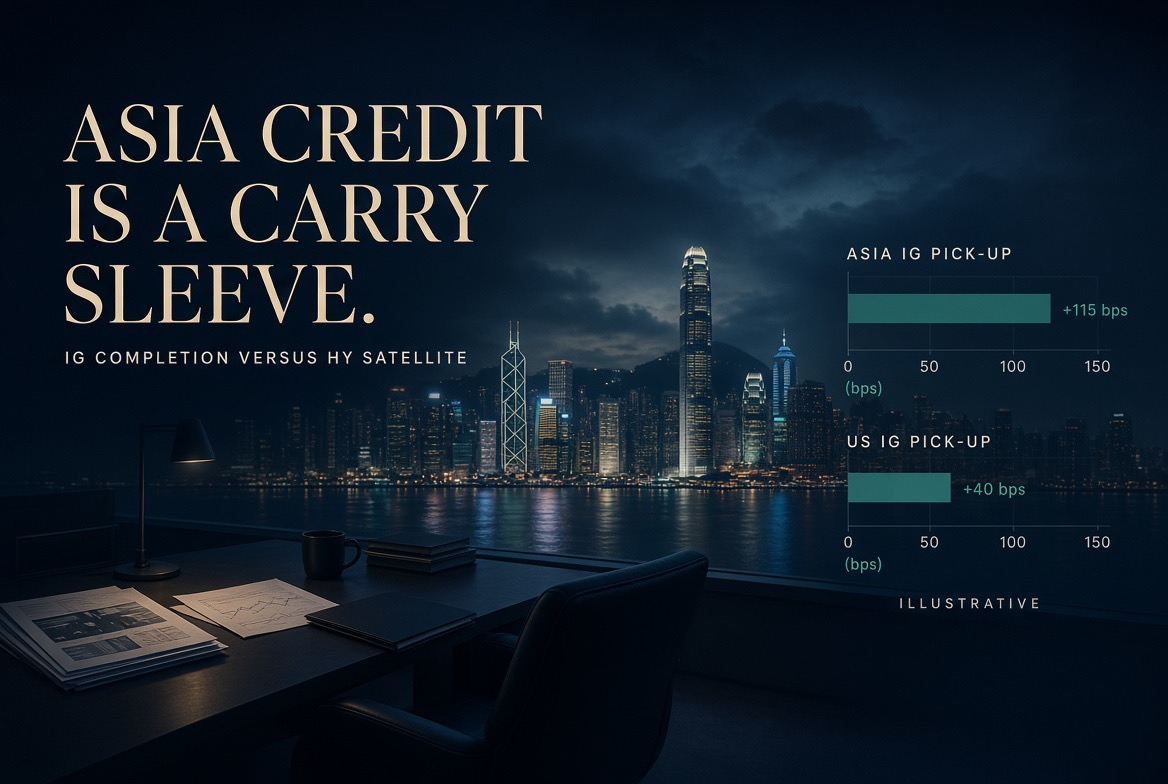
Asia Credit Is a Carry Sleeve. Spreads Are Not the Whole Story.

UBS GWM’s mid-2026 Asia note put Asia investment-grade all-in yields near 5.3 per cent and a 93 basis-point pick-up over same-tenor US Treasuries, against 64 basis points for US IG. Asia high-yield dollar paper has returned 4.3 per cent year to date against 1.8 per cent for US peers, Bloomberg data compiled by The Business Times show. The allocation question is carry and selection, not a spread-tightening thesis.

ADIA Raises Private Equity and Hedge-Fund Ranges, Cuts the Real-Estate Band

Asset Owners

17 Sep 2026

ADIA Raises Private Equity and Hedge-Fund Ranges, Cuts the Real-Estate Band

The Abu Dhabi Investment Authority’s 2025 review lifts the private-equity policy range to 15–20 per cent and financial alternatives to 7–12 per cent. The real-estate range falls to 2–7 per cent. Absolute property exposure is described as unchanged. Twenty-year annualised return: 6.6 per cent.

Asia DPM Allocation After US Concentration

Private Wealth

16 Sep 2026

Asia DPM Allocation After US Concentration

Discretionary books in the region are being rebuilt around a reduction in US equity weight. Lombard Odier’s published 2026 Asia DPM stance overweight emerging-market equities, underweight US equities, holds fixed income neutral with an EM-bond tilt, uses convertibles for optionality and treats gold as a core holding. Digital assets are excluded.

GPIF vs NPS: Two Giant Policy Mixes, Two Different Problems for Managers

Asset Owners

16 Sep 2026

GPIF vs NPS: Two Giant Policy Mixes, Two Different Problems for Managers

Japan’s Government Pension Investment Fund continues to operate a four-box listed policy mix, with alternatives limited to 5 per cent inside those boxes. Korea’s National Pension Service has written a 14 per cent alternatives allocation, including private debt, into its 2026 plan. The two funds sit in the same regional coverage universe. Their mandates do not.

Institutional Insurance Allocator Development

Asset Owners

6 Aug 2026

Institutional Insurance Allocator Development

In response to worsening regional market volatility, Etiqa Insurance Singapore has structured a new non-participating endowment plan utilizing a regime-aware asset rotation index to preserve institutional balance sheets while maintaining market exposure.

The Spread Duration Trap: Institutional Asset Allocators Pivot Toward Defensive Infrastructure and Physical Real Assets

Opinion

4 Aug 2026

The Spread Duration Trap: Institutional Asset Allocators Pivot Toward Defensive Infrastructure and Physical Real Assets

As single-stock volatility surges rapidly underneath artificially calm index surfaces, prominent macroeconomic research directs multi-asset allocators to rotate liquidity out of crowded equity trades to secure downside protection. By shifting focus away from over-concentrated, tech-heavy public benchmarks, modern portfolios are prioritizing tangible structural sectors to navigate intensifying valuation dispersion.

Live Intelligence Network

Subscribe to InvestIQ Asia

Independent intelligence for CIOs, asset owners, private-bank investment leads, and institutional managers across Asia Pacific.

Managed by InvestIQ Asia Research. Primary-source analysis of capital deployment and portfolio decisions.