KKR’s mid-2026 Asia credit note describes a market that is no longer an emerging-markets junk sleeve. On its reading of ICE and related indices as of late May 2026, more than 90 per cent of Asia liquid credit is investment grade, and China real-estate exposure inside Asia high yield has fallen from 45 per cent to 3 per cent. Country mix has shifted toward Japan, Australia, Korea and India as China’s weight has receded. Somewhere between 60 and 70 per cent of the book sits in developed or investment-grade Asia. About 70 per cent is linked, directly or indirectly, to sovereign or quasi-sovereign risk.
That composition change is the first insight. A global IG completion sleeve and a 2018-style Asia HY property sleeve are not the same product. Managers still selling “Asia credit” as a high-beta EM overlay are describing an older index.
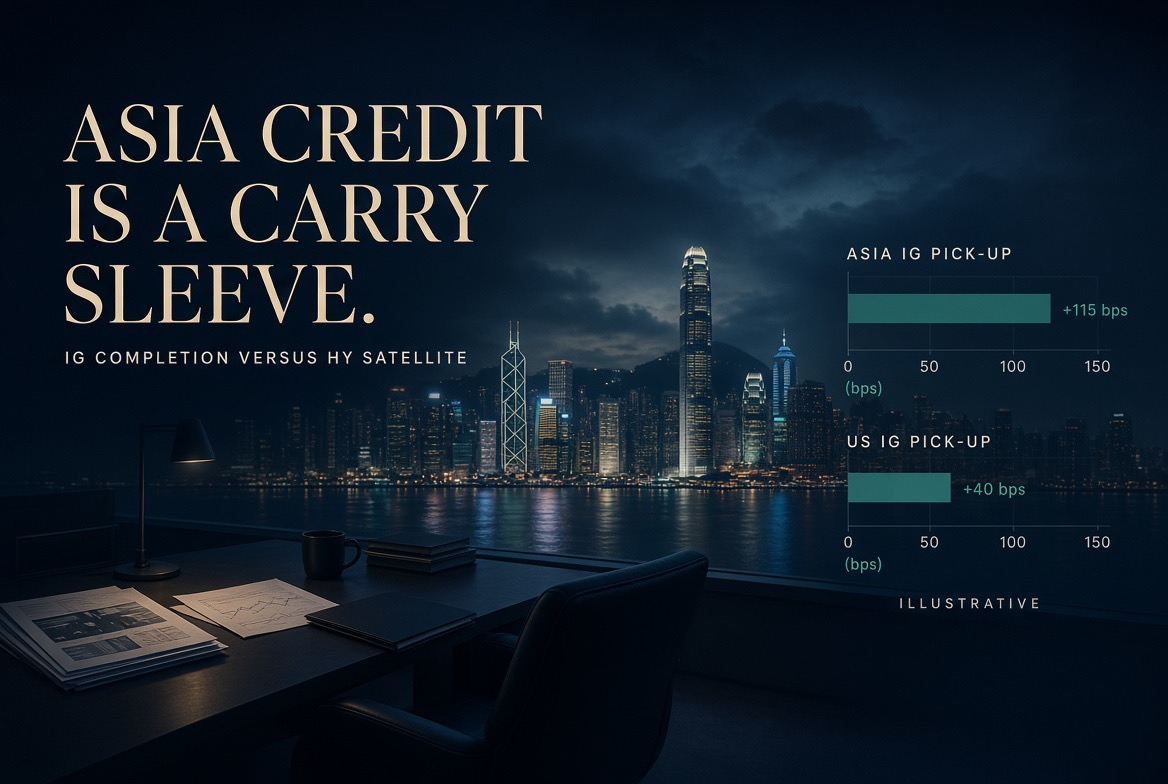
Carry is the second. UBS CIO GWM, in its June 2026 Investing in Asia Pacific note, called Asia IG and HY attractive. Asia IG yields were put at about 5.3 per cent. The pick-up over same-tenor US Treasuries was 93 basis points, against 64 basis points for US IG. Duration preference in that note was short to medium term. Preferred expressions included China IG, financials including selected bank subordinated debt, selected Macau gaming names and improving commodity credits.
Invesco’s Q4 2026 Asia IG outlook, from Chris Lau, is consistent on the engine of return. Spreads are tight. Outcomes are expected to come from carry, security selection and duration discipline, not from a further material tightening. Preferred exposures in that note include China IG, Korean financials, Hong Kong insurers and selected Australian credits.
High yield has been the 2026 performance surprise on the Bloomberg compilation published by The Business Times on 15 September: Asia HY dollar bonds 4.3 per cent year to date against 1.8 per cent for US HY, ahead of two dozen global debt gauges. Issuance remains small. Asia ex-Japan non-financial HY dollar supply was about $12 billion year to date, against more than $220 billion in the US. The market can outperform without being large enough to absorb a global HY reallocation.
“Investors may begin migrating up the credit curve, favouring higher-rated credits where yields remain attractive without requiring them to assume the same level of default risk.”
Melvin Chan, Director of Fixed Income, Asia, UOB Asset Management, September 2026
Dhiraj Bajaj, CIO of Asia fixed income and equities at Lombard Odier Investment Managers, said the house continues to project “high single-digit returns for this year and the coming years given ample opportunity.”
Those sentences describe a quality-and-carry book, not a distressed cycle. They sit beside PIMCO’s broader 2026 view that lower-quality and private direct-lending losses are rising in other markets. Asia public IG, on the KKR and UBS descriptions, is a different credit animal from US mid-market private credit.
For a CIO or a DPM fixed-income sleeve, the committee question is whether Asia credit is held as a 93 basis-point carry overlay with shorter duration than US IG, or as a high-yield satellite sized to a $12 billion issuance market. Those are two risk budgets. Combining them into one “Asia credit overweight” hides the rating and liquidity difference.