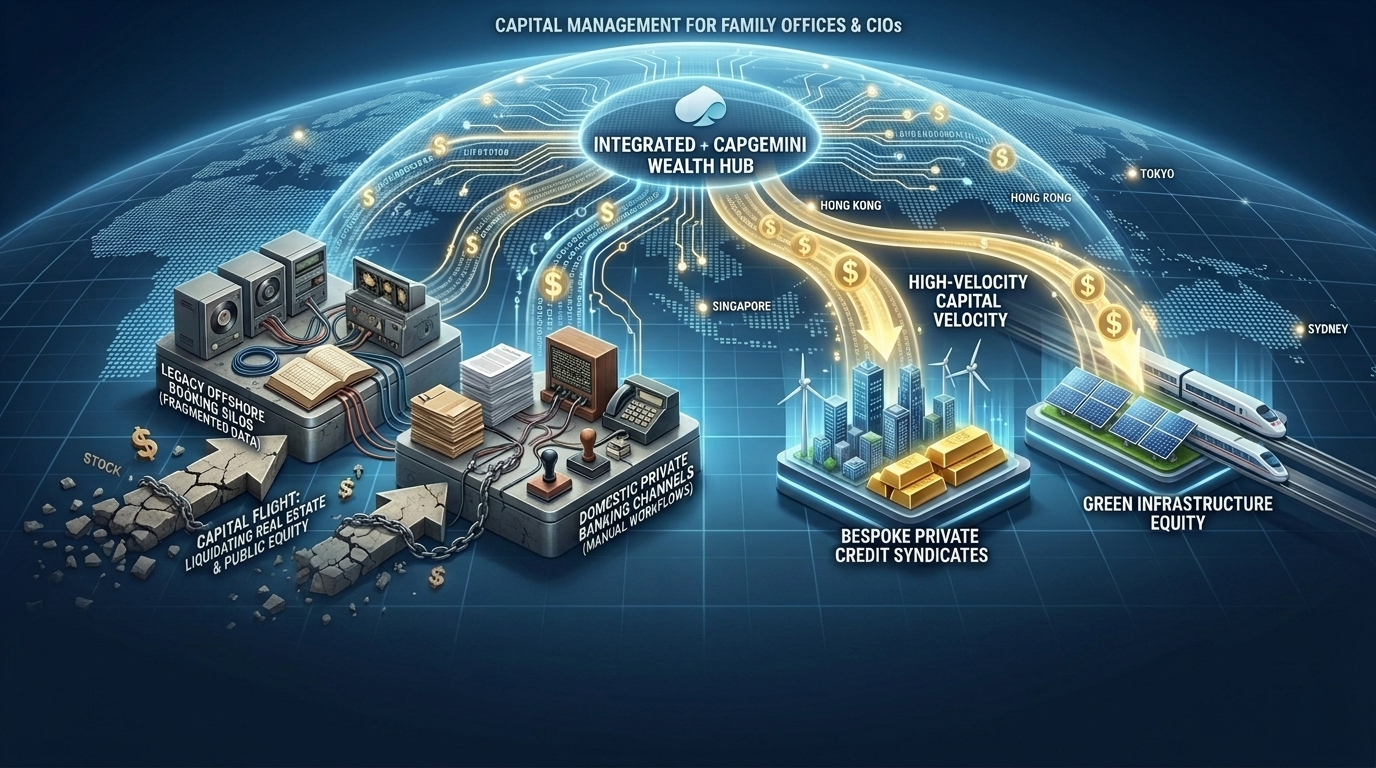
The private wealth management and multi-family office ecosystem across the Asia-Pacific corridor has entered an intensive structural transformation, driven by an unprecedented concentration of capital across primary regional booking hubs. Financial metrics compiled by the Capgemini Research Institute confirm that the regional high-net-worth individual population expanded by 4.8%, while total private wealth assets under management scaled by a robust 5.6%. This rapid wealth accumulation is forcing tier-1 wealth platforms to abandon legacy wealth preservation models, initiating a comprehensive overhaul of their core digital architectures to handle accelerating onshore and offshore capital flows.
To insulate their operating margins from smaller boutique wealth asset advisory firms, private banking institutions are aggressively dismantling legacy, highly fragmented geographical silos. Wealth committees are authorizing extensive structural integrations designed to merge offshore booking systems and domestic private banking channels into a single, high-velocity client execution loop. By removing the traditional administrative barriers that split core regional capital cities, these platform transformations enable single-family office CIOs and institutional wealth managers to distribute liquidity across alternative private debt opportunities seamlessly, enhancing transaction speed while eliminating duplicate cross-border compliance friction.
Addressing this multi-billion-dollar digital and operational restructuring, Nilesh Vaidya, Global Head of Wealth Management Banking Solutions at Capgemini, explicitly outlined the platform imperative:
"The unprecedented expansion of private wealth pools throughout the Asia-Pacific corridor is shifting the requirements of wealth platform delivery. Wealth managers can no longer rely on fragmented, legacy geographic silos or manual client workflows to defend their operating margins. To capture this capital velocity smoothly, top-tier platforms are aggressively overhauling their core digital architectures to seamlessly merge offshore booking registries with unified alternative asset placement channels."
This platform integration is further accelerated by an acute inheritance crisis building across Asia's primary business dynasties, where a growing percentage of private fortunes are entering active intergenerational transitions. Faced with widening cross-border disclosure laws and volatile public index concentration, institutional multi-family office directors are executing an aggressive capital rotation playbook. Wealth desks are systematically re-allocating substantial liquidity tranches out of compressed commercial real estate assets and plain-vanilla public equity benchmarks, shifting capital instead into bespoke private credit lending syndicates, green infrastructure equity, and physical gold hedges to guarantee absolute downside portfolio protection.