"Our mid-year indicators confirm that investing in the broader technology megatrend via a generalized, tech-heavy index has become an increasingly inefficient mechanism to capture long-term alternative upside. To guard the gains of this resilient but volatile bull market, multi-family office investors must intentionally rotate capital away from over-concentrated mega-cap equities. Survival in this high-dispersion regime requires a structural migration into targeted subthemes, structured solutions with embedded downside protection, and tangible real assets."Concurrently, our editorial team tracks a parallel capital migration into the physical commodity complex as macro investors look to protect portfolios from persistent cross-border inflation volatility. Since the pandemic market lows six years ago, the Bloomberg Equal-Weight Commodity Index has advanced by a striking 74% in USD terms, yielding a highly consistent 19% annualized return. Over this exact same multi-year window, global sovereign bond registries have consistently lost money even after incorporating contractual coupon payments. This prolonged performance decoupling confirms that in a multipolar world marked by persistent maritime supply chain friction and energy security rebalancing, physical raw materials have graduated into a non-negotiable anchor for multi-asset capital protection loops.
InvestIQ Asia Research · Tuesday, 28 July 2026 · invest-iq.asia/story/the-tech-index-inefficiency-bnp-paribas-overhauls-allocation-framework-as-tech-s-e3abe2
Private Wealth
The Tech Index Inefficiency: BNP Paribas Overhauls Allocation Framework as Tech Sector Dispersion Hits Historic Highs
IQ
InvestIQ Asia Research Desk
Asia Pacific · Tuesday, 28 July 2026
2 min read
As creative disruption fractures legacy software channels, a definitive 2026 mid-year strategy update from BNP Paribas Wealth Management outlines why elite investors must abandon broad-market indexing to shield capital from localized tech drawdowns.
Key Takeaways
- The Indexing Inefficiency Floor: Macro portfolio tracking confirms that broad tech-heavy indexes (such as the Nasdaq 100) have become highly inefficient vehicles for capturing genuine AI theme upside due to severe asset dispersion.
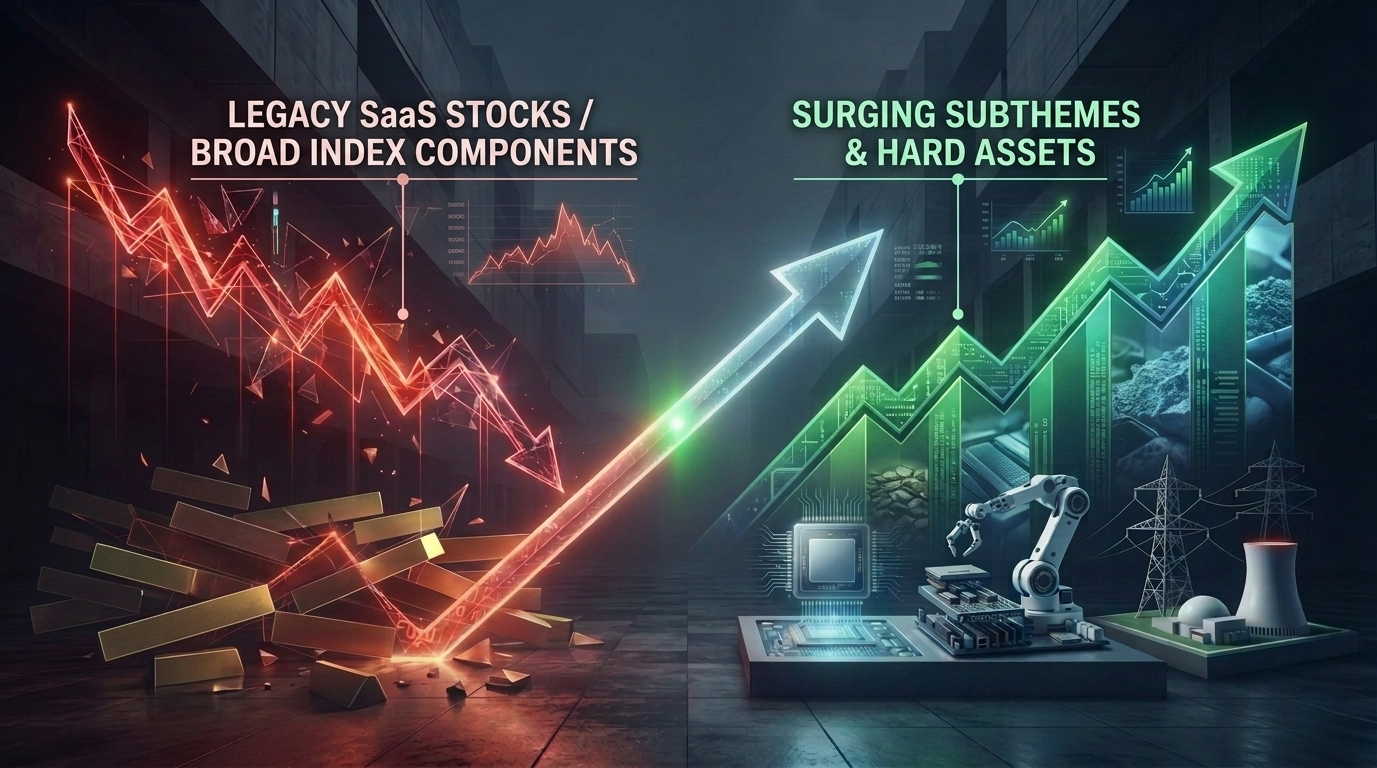
- Software Sub-Tranche Selloff: While specialized hardware sectors have surged up to 184%, Software-as-a-Service (SaaS) providers have suffered a 24% contraction due to automated AI coding disruptions.
- Commodity Allocation Premium: Long-term asset tracking reveals the Bloomberg Equal-Weight Commodity Index advanced 74% over a six-year rolling window, heavily outpacing public fixed-income registries.
- Strict Intermediary Isolation: This specialized wealth tracking matrix operates under rigid client-tiering rules, completely cutting off mass-retail networks from our interface layout.
The private wealth management and multi-family office ecosystem across primary international hubs has entered a highly complex allocation phase, characterized by historic levels of return dispersion inside the global technology and digital infrastructure registries. According to the newly finalized 2026 Investment Themes Mid-Year Update published by BNP Paribas Wealth Management, the rapid rollout of next-generation autonomous tools is creating an aggressive wave of creative destruction. While the broader equity bull market has displayed extreme resilience entering its fourth consecutive year, underlying sector mechanics demonstrate that passive, broad-market index replication is exposing multi-asset investors to unhedged concentration traps and hidden capital erosion.
The empirical data compiled in the wealth giant's global research portfolio highlights a profound divergence between perceived tech winners and structural losers. On one side of the ledger, memory chipmakers, advanced robotics hardware developers, and data center electricity transmission networks have experienced massive institutional capital injections, with targeted subthemes achieving gains ranging from 26% to 184%. Conversely, Software-as-a-Service (SaaS) providers and legacy enterprise application channels have faced an intensive sector selloff, contracting by 24% as advanced agentic software engines disrupt stable, high-margin software licensing business models. This deep variance proves that broad passive benchmarks are no longer capable of insulating elite client reserves from localized technology drawdowns.
Detailing this structural tech bifurcation and the required shifts in multi-generational wealth preservation strategies, Edmund Shing, Global Chief Investment Officer at BNP Paribas Wealth Management, verified the platform's core directive:
Consequently, the wealth management platform’s updated asset allocation mandate shifts focus entirely toward localized, high-barrier alternative channels. To insulate multi-family office portfolios from the ongoing "Patchmageddon" software cycle and duration shocks, investment committees are prioritizing smart-grid electrification, nuclear power infrastructure debt, and specialized evergreen private credit syndicates. By embedding structural downside protection tools and currency-hedged wrappers directly into the core capital stack, top-tier private banks are ensuring that elite client assets remain fully insulated from mass-market retail volatility, locking in predictable, underwritten yields across the global trade corridor.
Source: InvestIQ Asia (https://invest-iq.asia/story/the-tech-index-inefficiency-bnp-paribas-overhauls-allocation-framework-as-tech-s-e3abe2). © InvestIQ Asia. All rights reserved. Single-reader licence; redistribution prohibited.
Comments
Sign in to join the conversation.
Sign in to commentLoading comments…