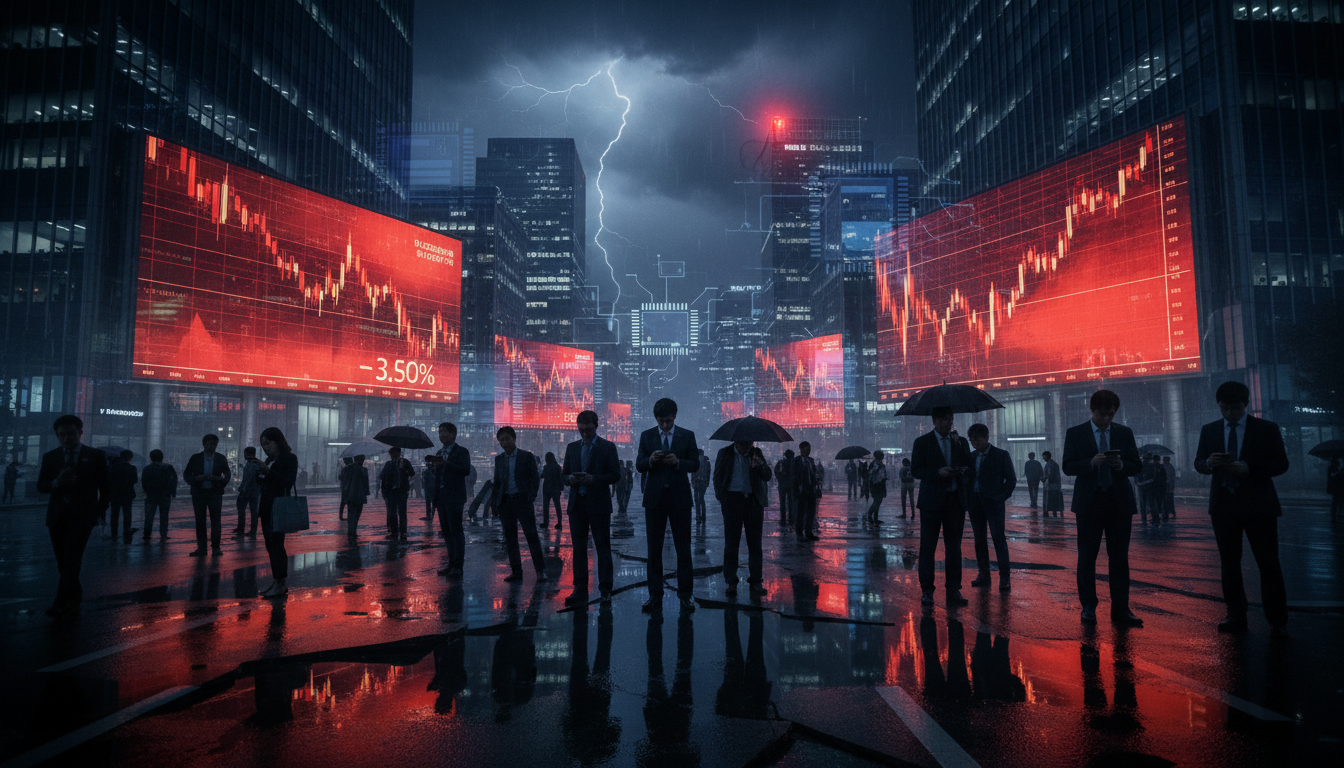
The artificial intelligence party in Seoul did not just end - it collapsed. On Tuesday, South Korea’s benchmark KOSPI index plummeted 8.18% to close at 7,392.04, marking one of the most violent single-day market capitulations in the country’s modern financial history.
The velocity of the crash caught investors entirely off guard, forcing the Korea Exchange (KRX) to activate an automatic "sidecar" circuit breaker to temporarily halt program trading. The emergency intervention, designed to prevent a total market freefall, did little to soothe nerves. By the time the closing bell rang, billions of dollars in market value had evaporated, sent packing by a aggressive wave of foreign capital flight and institutional de-risking.
For the first half of 2026, South Korea was celebrated as Asia’s best-performing equity market. The KOSPI had effectively doubled from its starting point near 4,300, riding a historic wave of global demand for high-bandwidth memory (HBM) and specialized AI hardware. But that hyper-concentration of wealth proved to be the market's undoing. Today's crash confirms the deep architectural vulnerabilities embedded in an index overwhelmingly dominated by just two players: Samsung Electronics and SK Hynix.
The Giants That Dragged Down the Bourse
To understand why the KOSPI buckled so spectacularly, one must look at the unprecedented concentration risk embedded in South Korea’s corporate landscape. Together, Samsung Electronics and SK Hynix represent more than half of the total weight of the index. When they catch a cold, the entire South Korean economy gets pneumonia. Today, they suffered structural fractures.
Paradoxically, the panic accelerated just as Samsung projected a staggering 19-fold jump in its second-quarter operating profits. In normal market conditions, such an exponential leap would spark a massive rally. Instead, investors treated the news as the absolute peak of the semiconductor supercycle.
Analysts noted that these historic earnings expectations had already been meticulously priced into the stock's astronomical valuation over the last six months. With no further positive surprises left in the pipeline, global asset managers executed a brutal "sell-the-news" strategy, rushing for the exits to lock in profits before a perceived cyclical downturn.
A Perfect Storm: From Gulf Risks to Leveraged Meltdowns
While structural valuation anxieties provided the dry tinder, a volatile mix of macroeconomic and geopolitical events served as the spark.
- Geopolitical Energy Shocks: Investor sentiment in early Asian trading was severely rattled by reports of an explosive attack on a Liquefied Natural Gas (LNG) carrier in the Gulf of Oman. Given South Korea's heavy reliance on imported energy to power its massive industrial facilities, the sudden threat to critical maritime shipping routes triggered an immediate pivot away from volatile equities.
- The Leveraged Retail Unwind: Domestic retail traders, long a driving force in the KOSPI, exacerbated the downward spiral. Financial regulators had recently warned of an unsustainable surge in investors using borrowed funds to purchase aggressive, single-stock leveraged ETFs tied directly to chipmakers. As institutional selling drove stock prices down, it triggered automated margin calls on these highly leveraged products, forcing liquidations that added immense momentum to the crash.
- Global Tech Contagion: The rout in Seoul did not happen in a vacuum. It directly tracked a sharp, overnight retreat in US technology futures and a broader defensive rotation across Europe and Asia. A delayed IPO from OpenAI and aggressive hardware price hikes from Apple have collectively forced global investors to ask a painful question: Is corporate spending on AI infrastructure yielding actual, sustainable profit, or is it merely speculative over-building?
What Lies Ahead: A Buying Opportunity or the First Domino?
The immediate aftermath of the crash has left the global investment community deeply divided. Optimists, including macro strategists at Goldman Sachs, argue that the fundamental underlying demand for AI compute infrastructure remains intact. From their perspective, this brutal reset is a healthy, long-overdue correction that will clear out speculative retail froth and allow the KOSPI's rally to safely broaden out into non-technology sectors in the second half of the year.
However, more defensive market observers are urging extreme caution. Legendary retail market analysts are warning ordinary investors to strictly avoid trying to "catch a falling knife" by day-trading individual semiconductor names. Instead, they advocate for shifting capital into broader index funds or defensive cash positions while the structural dust settles.
As trading volumes remain dangerously elevated and the local currency continues to weaken against the US dollar, the KOSPI's spectacular 8% plunge serves as a stark warning to markets worldwide. Tech valuations cannot outrun reality forever. If the massive corporate capital expenditures poured into artificial intelligence fail to translate into tangible, long-term corporate earnings, the shockwave that leveled Seoul today may soon arrive on Wall Street's doorstep.