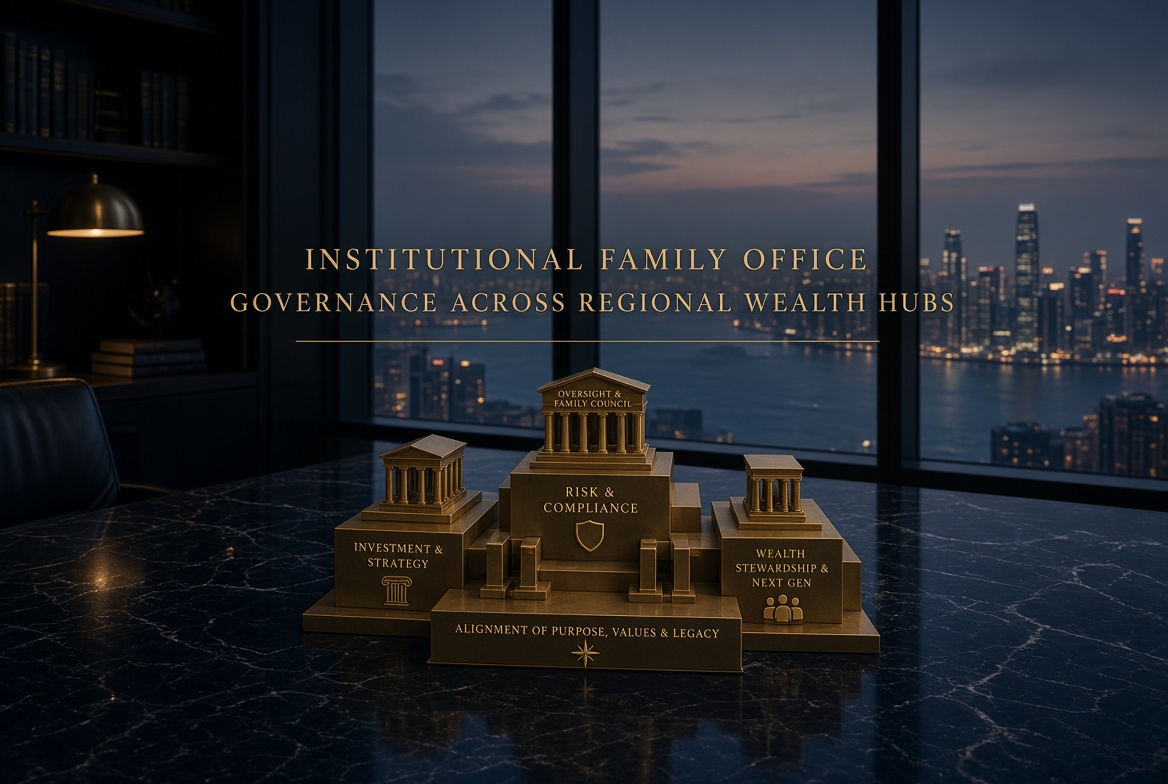
As wealth transfer accelerates across Hong Kong, Singapore, and emerging Southeast Asian financial hubs, next-generation family principals are systematically overhauling traditional wealth preservation models. For decades, single-family offices in the region operated on relationship-driven, opportunistic co-investments, relying heavily on informal networks and founder-led intuition. Today, however, that paradigm is giving way to institutional permanence. Wealth owners are establishing formal investment committees, hiring seasoned Chief Investment Officers out of global institutional funds, and deploying sophisticated portfolio management dashboards to monitor asset allocation in real time.
This professionalization wave is driven by a complex dual mandate: capturing sustainable, long-term yield in private equity and private credit markets while fortifying internal risk controls against heightened cybersecurity vulnerabilities and tightening cross-border regulatory scrutiny. As family offices grow in scale, their capital deployment increasingly mirrors that of institutional pension funds and sovereign wealth allocators. Consequently, the operational threshold required to access top-tier private market vintage funds has risen sharply. General partners and institutional fund managers now subject prospective family office allocators to rigorous operational due diligence, evaluating internal controls, compliance frameworks, and governance structures before accepting commitments.
Industry surveys and wealth management leadership roundtables across regional financial centers indicate that operational resilience has emerged as a primary board-level priority. While legacy allocators focused almost exclusively on raw deal flow and historic investment returns, modern single-family offices are institutionalizing strict dual-authorization payment controls, comprehensive vendor verification protocols, and enterprise-grade cybersecurity architectures. The realization that private wealth hubs in Singapore and Hong Kong are prime targets for sophisticated digital fraud has catalyzed this defensive posture. Protecting capital from operational failure is now viewed as equally important as generating alpha.
"The generational transition of wealth is not merely about shifting asset ownership, but about institutionalizing the operational framework that protects it against both market volatility and internal vulnerabilities."Professor Winnie Qian Peng, Director, Roger King Center for Asian Family Business and Family Office, HKUST
Beyond internal risk mitigation, the integration of modular corporate structures has transformed how family offices manage cross-border capital deployment. The adoption of Variable Capital Company umbrella fund frameworks in Singapore and equivalent segregated portfolio vehicles in Hong Kong allows wealth groups to ring-fence liabilities across distinct sub-funds while optimizing multi-jurisdictional tax efficiency. These structures provide the legal compartmentalization necessary to separate operating assets, philanthropic initiatives, and high-risk venture allocations.
Furthermore, this governance evolution extends to talent acquisition. Family offices are no longer viewed merely as lifestyle vehicles for extended family members, but as sophisticated financial institutions capable of attracting elite underwriting talent. By instituting transparent reporting channels, formalized incentive structures, and independent advisory boards, regional family wealth groups are positioning themselves as reliable, long-term co-investors. This structural maturity ensures that as private markets face higher cost-of-capital pressures and complex regulatory oversight, family capital remains resilient, disciplined, and fully integrated into the institutional mainstream.