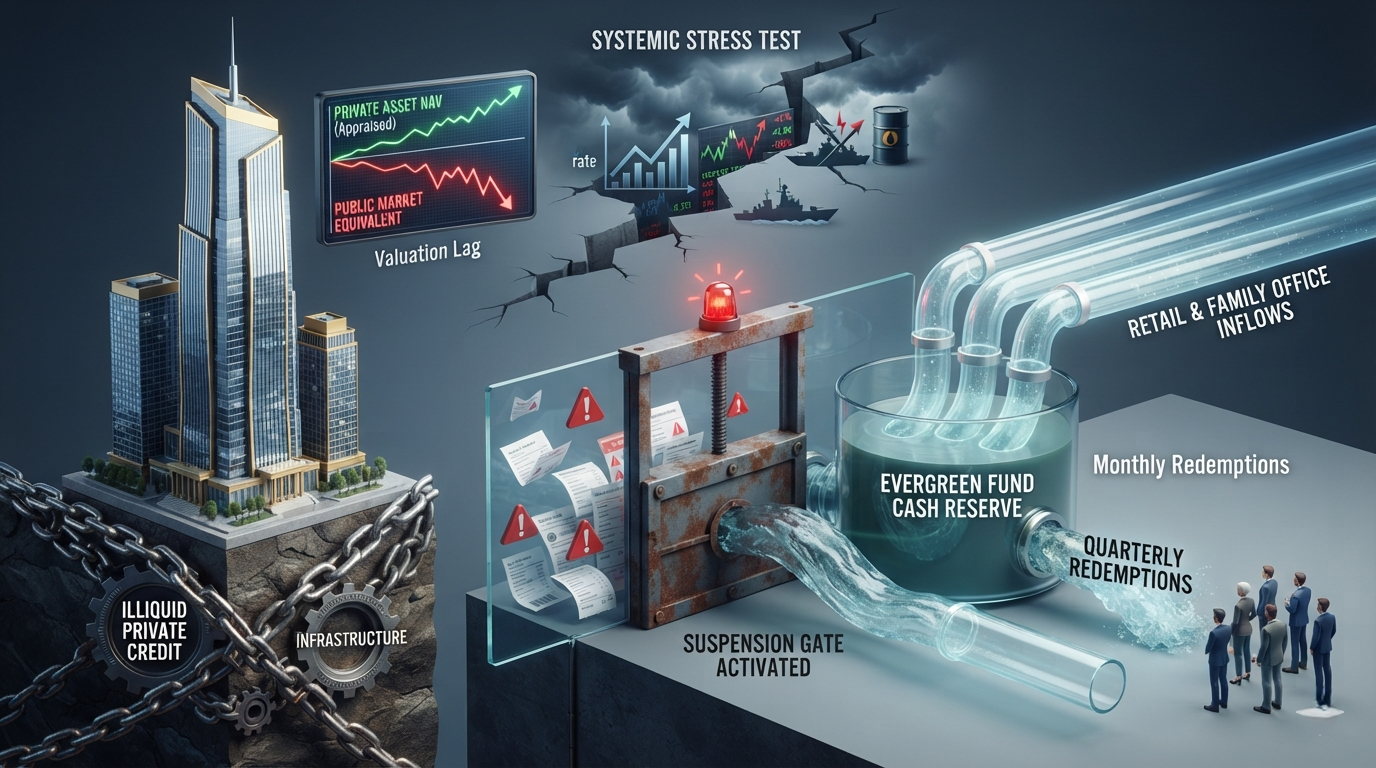
The structural architecture of modern alternative asset management has entered an intensive phase of operational evaluation. Over the past ten years, the financial services industry celebrated the "democratization" of private markets, a commercial phenomenon driven almost entirely by the proliferation of semi-liquid perpetual vehicles. These evergreen frameworks successfully captured hundreds of billions of dollars from high-net-worth (HNW) individuals, multi-family offices, and regional foundations by promising the best of both worlds: access to the illiquidity premium of unlisted corporate loans and infrastructure assets, paired with the structural flexibility of periodic liquidity windows. Yet, this entire capital gathering triumph operates under an optimization model that assumes normal, continuous inflows. When the macroeconomic tide turns, the operational boundary between theoretical liquidity and realized asset locks becomes perilously narrow.
The Structural Duration Disconnect
The core vulnerability of the evergreen format resides in an inescapable baseline reality: no structural wrapper can magically transform an inherently illiquid underlying asset into a liquid one. A multi-year mid-market corporate loan, a physical logistics grid, or an underwritten infrastructure project cannot be liquidated on a monthly basis to meet a sudden surge in investor redemption requests without incurring catastrophic fire-sale valuation penalties.
During prolonged periods of macroeconomic expansion, this disconnect remains hidden. New subscriptions from wealth management networks comfortably cover the modest stream of exiting investors, allowing the fund to maintain an optimized, fully deployed investment posture. However, when central bank policy shifts compress public market returns or trigger localized operational volatility, private wealth networks tend to act in a highly correlated manner. A sudden, simultaneous spike in redemption requests across multiple distribution channels instantly drains a fund’s liquid cash sleeves. To safeguard the structural integrity of the master portfolio, asset managers are left with no choice but to activate their built-in defensive guardrails, deploying strict redemption caps, invoking side-pockets, or executing absolute withdrawal suspension gates. For the private investor who treated these platforms as a low-volatility, cash-substitute alternative, the mirage of flexible capital allocation instantly evaporates.
Valuation Lag and Arbitrage Mechanics
A secondary, equally severe friction point within the perpetual architecture is the systemic valuation lag inherent in private asset registries. While public equities and liquid fixed-income benchmarks price instantaneously in response to interest rate adjustments, geopolitical shocks, and corporate earnings revisions, the unlisted assets held inside evergreen portfolios do not. These private holdings rely on periodic, backward-looking appraisal methodologies, often driven by discounted cash flow (DCF) models, independent valuation committees, or subjective peer-group asset comparisons.
During a broad macro contraction, this creates an unhedged valuation gap. The private vehicle's net asset value (NAV) remains artificially elevated or "smoothed," while public equivalents drop significantly. This discrepancy creates a clear structural arbitrage opportunity for sophisticated investors and institutional asset owners. Recognizing that the private fund’s stated NAV is temporarily stale, early-moving investors aggressively file for redemptions, effectively cashing out their shares at peak valuations that no longer reflect the true underling market landscape.
This dynamic causes a silent, highly damaging intergenerational wealth transfer within the fund itself. Because the cash used to pay out these exiting investors does not come from selling down the long-term private portfolio, it must be carved directly out of the vehicle's liquid reserves or funded by the incoming subscriptions of new, unsuspecting retail investors. Consequently, the long-term investors who remain inside the fund are left holding an increasingly concentrated pool of illiquid, unhedged assets, while their protective cash buffers are systematically depleted to subsidize early exits.
The Compounding Corporate Refinancing Wall
As semi-liquid platforms navigate these internal redemption headwinds, the underlying assets within their portfolios are simultaneously colliding with a challenging operational refinancing environment. A significant volume of the middle-market corporate credit and real estate debt sitting inside current evergreen portfolios was originally underwritten during periods of ultra-low baseline borrowing costs. Over the coming cyclical window, a massive wall of these legacy unlisted loans is scheduled to mature, forcing corporate borrowers to approach private debt originators for total refinancing.
In a normalized, structurally higher interest rate environment, this refinancing process triggers immediate credit strain. Corporate borrowers are forced to accept significantly higher floating-rate coupon protections, which rapidly compresses their internal interest coverage ratios and drives up overall corporate leverage metrics. For evergreen fund managers, this asset degradation occurs at the worst possible moment. As default trends and non-performing loan metrics tick upward across mid-market corporate portfolios, the net yields generated by the private assets begin to erode. The fund's underlying performance begins to deteriorate precisely when global wealth desks are demanding their capital back, permanently altering the capital stack. Survival in this regime requires absolute cash flow velocity, forcing forward-looking asset owners to bypass opaque, long-duration setups entirely in favor of direct partnerships, transparent structures, and short-duration private credit originations that guarantee true cash visibility.