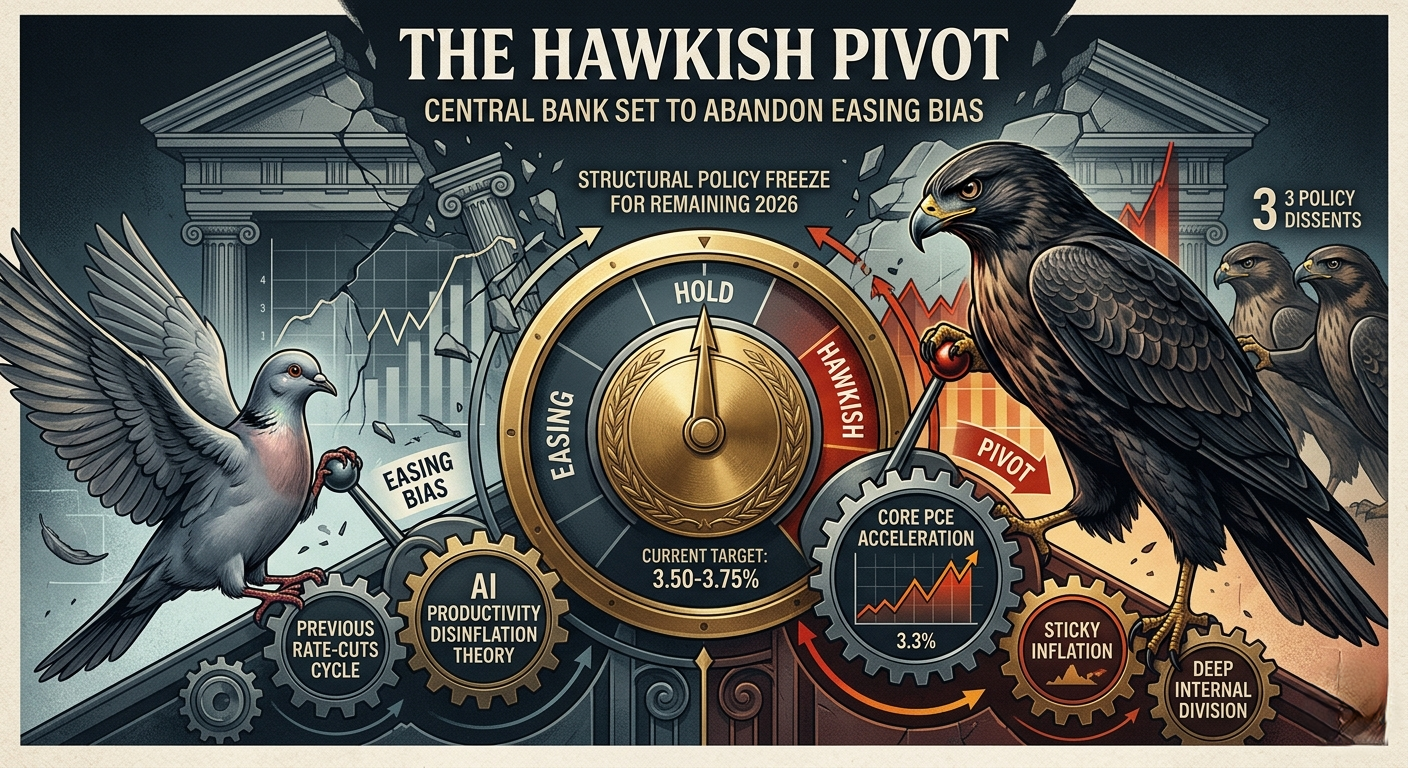
The Federal Open Market Committee (FOMC) is poised to hold the federal funds target range steady at 3.50-3.75% during its June 16-17 meeting. While this decision aligns cleanly with prevailing market pricing and consensus forecasts, the true significance lies in an impending structural policy pivot. The central bank is highly likely to formally remove the easing bias that has anchored its monetary strategy since the inception of the rate-cutting cycle in September 2024.
This policy pivot signals a fundamental realignment of the Federal Reserve's reaction function. Driven by a data-dependent landscape, the change acknowledges that persistent inflation risks have officially dismantled the case for near-term accommodation.
A Fractured Committee and Geopolitical Pressures
Incoming Chair Kevin Warsh takes the helm in an exceptionally complicated macroeconomic and institutional environment. He inherits a Federal Reserve board that stands as the most deeply divided Committee witnessed in over three decades.
Internal policy friction has reached a boiling point. Three voting members dissented against the easing bias in April, directly contrasting with outgoing Governor Stephen Miran, who voted in favor of a rate cut. Recent policy minutes reveal that the Committee's center of gravity has structurally drifted in a hawkish direction. This shift is reinforced by mounting uncertainty surrounding the duration and global economic spillover of ongoing Middle East geopolitical friction.
Core PCE Acceleration and Second-Round Inflation Risks
Recent real-economy data has offered the Federal Reserve no justification to continue cutting. Core PCE inflation - the central bank's primary benchmark for assessing underlying price behavior - accelerated to a sharp 3.3% in April, marking its highest reading in more than two years.
Concurrently, secondary economic indicators confirm that price pressures are broadening:
- The Beige Book Signal: The latest report explicitly highlighted the emergence of second-round inflation effects alongside moderate-to-strong price increases across various economic districts.
- Labor Market Stabilization: Resilient domestic activity and stabilizing employment conditions have eliminated any immediate pressure on the central bank to support the labor market via monetary expansion.
Consequently, the updated Summary of Economic Projections and the accompanying dot plot are highly likely to feature upward revisions to near-term inflation projections. Meanwhile, the medium-term growth outlook should remain unchanged, sustained by structural optimism regarding productivity gains.
The Warsh Doctrine: AI Productivity vs. Traditional Hawkishness
Kevin Warsh's inaugural press conference will serve as a crucial test of market transparency. The incoming Chair will face immediate questioning regarding his stated ambition to execute a full-scale "regime change" in American monetary policy.
While his historical reputation brands him a traditional inflation hawk, Warsh simultaneously champions an alternative long-term thesis. He posits that a structural, artificial intelligence- and productivity-driven disinflationary wave, paired with an aggressive reduction of the Federal Reserve’s balance sheet, will eventually justify structurally lower long-term interest rates.
However, this nuanced view is not widely shared among current voting members. This intellectual divide within the Committee could severely complicate policy coordination over the coming months.
Preparing for an Extended Monetary Freeze
In a rapidly evolving economic and geopolitical environment, AllianzGI projects that the FOMC will remain completely on hold for the remainder of this year. Resilient economic expansion, stabilizing domestic employment, and mounting inflation data have fundamentally skewed the balance of risks toward a hawkish regime.
For institutional investors, the removal of the easing bias demands an immediate recalibration of fixed-income and duration strategies. The path toward lower interest rates has been blocked by macroeconomic realities, and capital markets must now adapt to a structural era of higher-for-longer monetary policy.