The asset management industry has spent years indulging in rhetorical declarations regarding its commitment to financing the Asia-Pacific region’s massive decarbonisation transition. However, the glaring gap between climate capital commitments and real-world deployment reveals a fundamental structural flaw in current private market mechanisms. The traditional model of constructing bespoke, ad-hoc sustainability projects is completely incapable of mobilizing institutional capital at the necessary multi-trillion-dollar scale.
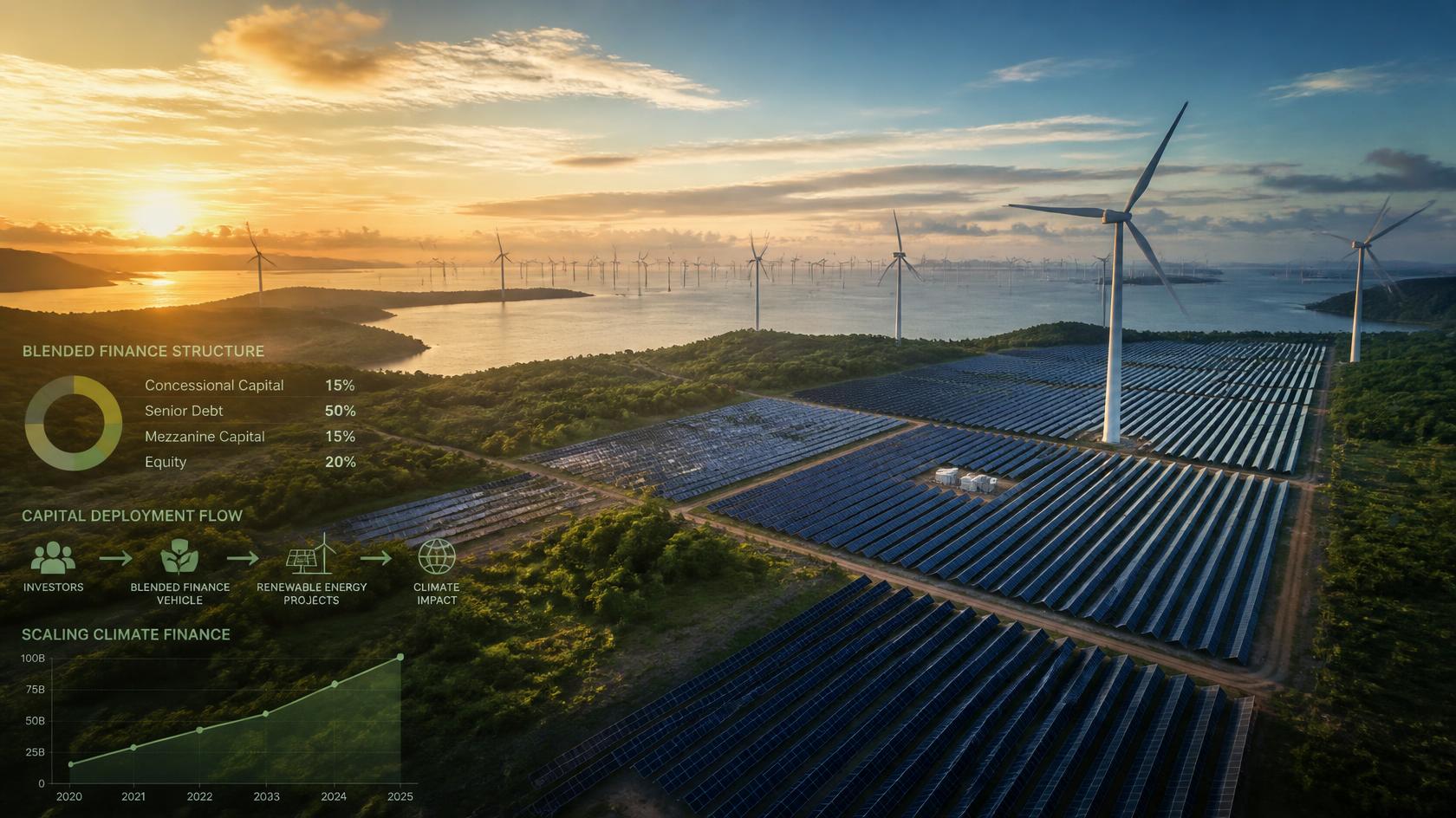
To truly bridge the regional climate finance deficit, asset managers must aggressively transition toward standardized, highly repeatable blended finance architectures. The recent eight hundred million dollar second close of the Green Investments Partnership under Singapore's Financing Asia’s Transition Partnership framework demonstrates the undeniable validity of this programmatic approach. This mechanism succeeds precisely because it abandons the romanticism of the one-off deal in favour of industrialised capital aggregation.
The structural brilliance of this model lies in its mechanical allocation of public and philanthropic concessional capital to systematically de-risk emerging market infrastructure. By utilizing sovereign balance sheets to absorb first-loss positions or provide subsidized funding lines, these partnerships transform marginally bankable projects into highly attractive investment-grade opportunities. This catalytic conversion is the only realistic method for unlocking conservative institutional balance sheets, such as global pension funds and insurance portfolios.
Developing economies across South and Southeast Asia require an astronomical sum annually to achieve mandatory development and emission targets simultaneously. Yet, the vast majority of international private capital remains paralyzed on the sidelines due to perceived macroeconomic risks, currency volatility, and local regulatory uncertainties. Asset managers cannot alter these sovereign risk profiles individually, but they can utilize blended architectures to neutralize them.
The transition toward repeatable structures requires a profound shift in the cultural mindset of alternative investment teams. Portfolio managers must stop treating green infrastructure as a specialized boutique asset class requiring artisanal structuring for every individual asset. Instead, the industry needs to establish unified credit rating frameworks, standardized documentation, and automated impact metrics that can be easily digested by institutional selectors.
Furthermore, the introduction of synthetic securitization tools and advanced risk-transfer instruments can dramatically expand the lending headroom of multilateral development banks. By transferring the commercial tranches of existing transition loans to private asset managers, these development institutions can recycle their precious concessional capital into brand-new green pipelines. This continuous velocity of capital is essential for maintaining momentum across regional grid modernization and fossil-fuel displacement initiatives.
The asset management community must also recognize that climate adaptation finance is rapidly evolving from a technical infrastructure challenge into a core corporate resilience strategy. Investments in coastal protection, localized heat mitigation, and water conservation infrastructure generate profound economic value by preventing multi-billion-dollar future insurance losses. Capturing this preventative value requires alternative managers to engineer innovative, cash-flow-generative fund models that reward long-term capital deployment.
Parametric insurance models and high-integrity carbon credit transfer mechanisms under emerging global frameworks must be integrated directly into these blended funds. These sophisticated financial layers provide essential liquidity buffers during severe climate dislocations, ensuring the operational continuity of underlying infrastructure assets. This comprehensive risk-mitigation ecosystem directly directly addresses the volatility concerns of conservative institutional investors.
Critics frequently argue that blended finance models distort natural market pricing mechanism and create unhealthy dependencies on public subsidies. This short-sighted perspective fails to comprehend the sheer scale of the global environmental externalities that traditional market mechanisms have comprehensively failed to price. Concessional capital is not a permanent subsidy, but rather a temporary structural bridge required to establish mature, self-sustaining green asset markets.
The regional investment management industry stands at a critical operational crossroads where reputational survival depends on execution efficiency. Continued reliance on boutique sustainability narratives will result in institutional irrelevance as investors increasingly demand transparent, large-scale deployment verification. Only those asset managers who master the industrial mechanics of scalable blended finance will command the future of Asia-Pacific transition capital.