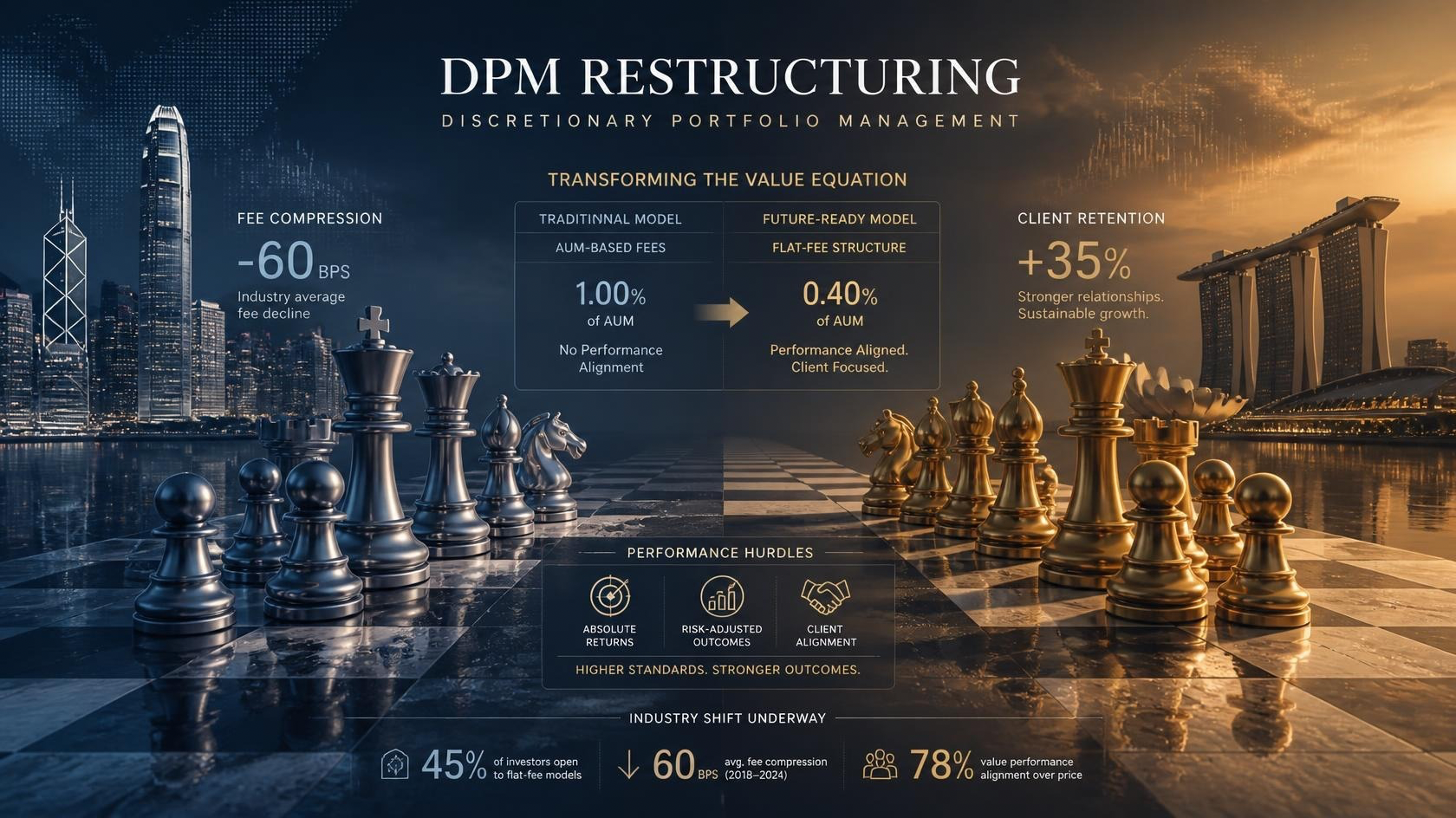
The competitive distribution landscape for high-net-worth client assets across the primary Pan-Asian wealth hubs has entered an intense phase of commercial reorganization as tier-one private banking institutions fundamentally adjust their product pricing models. This operational turnaround is highlighted by a major strategic restructuring finalized across the Asia-Pacific wealth channels of Citi Private Bank today, Wednesday, 2 September 2026. Historically, global wealth management groups operated on a highly predictable, volume-based revenue framework, charging a fixed percentage on a client's aggregate Assets Under Management to handle their Discretionary Portfolio Management mandates. However, fresh competitive intelligence indicates that modern wealth creators and incoming next-generation wealth inheritors are pushing back hard against these legacy, non-aligned fee structures. To combat rapid account attrition and defend its core relationship franchises, the American banking giant is actively rolling out customized flat-fee structures and strict absolute-return performance hurdles.
The core operational driver behind this aggressive pricing overhauling is the rapid maturation and expansion of the independent External Asset Manager and boutique multi-family office ecosystem across the Singapore and Hong Kong financial corridors. Over the past twenty-four months, highly successful senior private banking directors possessing extensive cross-border client books have systematically departed legacy institutions to launch agile, independent firms, offering ultra-high-net-worth families un-bundled fee transparency and open-architecture access to global markets. Because these independent boutique players aggressively highlight the hidden product transaction costs and layered platform fees embedded within traditional private banking spaces, major banking groups can no longer rely on brand historical prestige alone to maintain client loyalty. Weaponizing their massive scale and alternative balance-sheet revenue streams, premier global private banks are retaliating by launching institutional-grade DPM schedules that align the bank's compensation directly with real-world investment outperformance.
By implementing these sophisticated performance-linked fee matrices, relationship management desks are effectively transforming the standard private banking conversation from a simple transaction-driven sale into a highly aligned fiduciary partnership. Under a typical modernized DPM structure, the bank completely waives its baseline annual management fee, choosing instead to collect revenues exclusively when the customized client portfolio outpaces pre-negotiated absolute return hurdles or sovereign benchmark indices. This highly aligned framework provides affluent families with absolute cost insulation during periods of severe public market corrections and macro volatility, ensuring that the bank is never financially rewarded for passive index underperformance or capital erosion across a family's core wealth preservation containers.
Concurrently, this sweeping commercial transition is forcing an intense operational upgrade across the internal portfolio management benches of the major global private banking networks. To protect their operating margins under a performance-driven revenue regime, private banks are rapidly abandoning passive, third-party mutual fund selections in favor of direct, institutional-grade equity curation and specialized alternative credit originations. Internal investment teams are leveraging advanced machine-learning analytics to execute high-precision factor tilts, optimize corporate tax efficiency, and build highly customized thematic stock modules tailored specifically to the multi-jurisdictional compliance requirements of next-generation wealth inheritors. This extensive integration of product engineering and direct asset curation ensures that the private bank retains absolute control over the high-value capital pipeline while delivering transparent, un-levered alpha that boutique independent operators struggle to replicate.
An intense consolidation of private wealth capital into elite banking institutions that possess absolute product engineering agility and the capital depth to sustain performance-aligned fee concessions is accelerating across the regional corridors. Wealth houses and retail brokerages that fail to transition from legacy, commission-driven transaction structures to institutional-grade, fiduciary portfolio management faces immediate operational obsolescence. The private banking networks and subscription news sites that thrive during this cyclical realignment will be those that accept the new reality of absolute data transparency and optimize their interface delivery engines to display real-time, net-of-fee performance metrics and absolute fee-alignment models natively. By accepting the permanent obsolescence of legacy asset-based pricing and traditional product-pushing sales tactics, premier global wealth gatekeepers can successfully position their advisory frameworks to ensure true multi-generational client retention across a rapidly evolving global financial landscape.