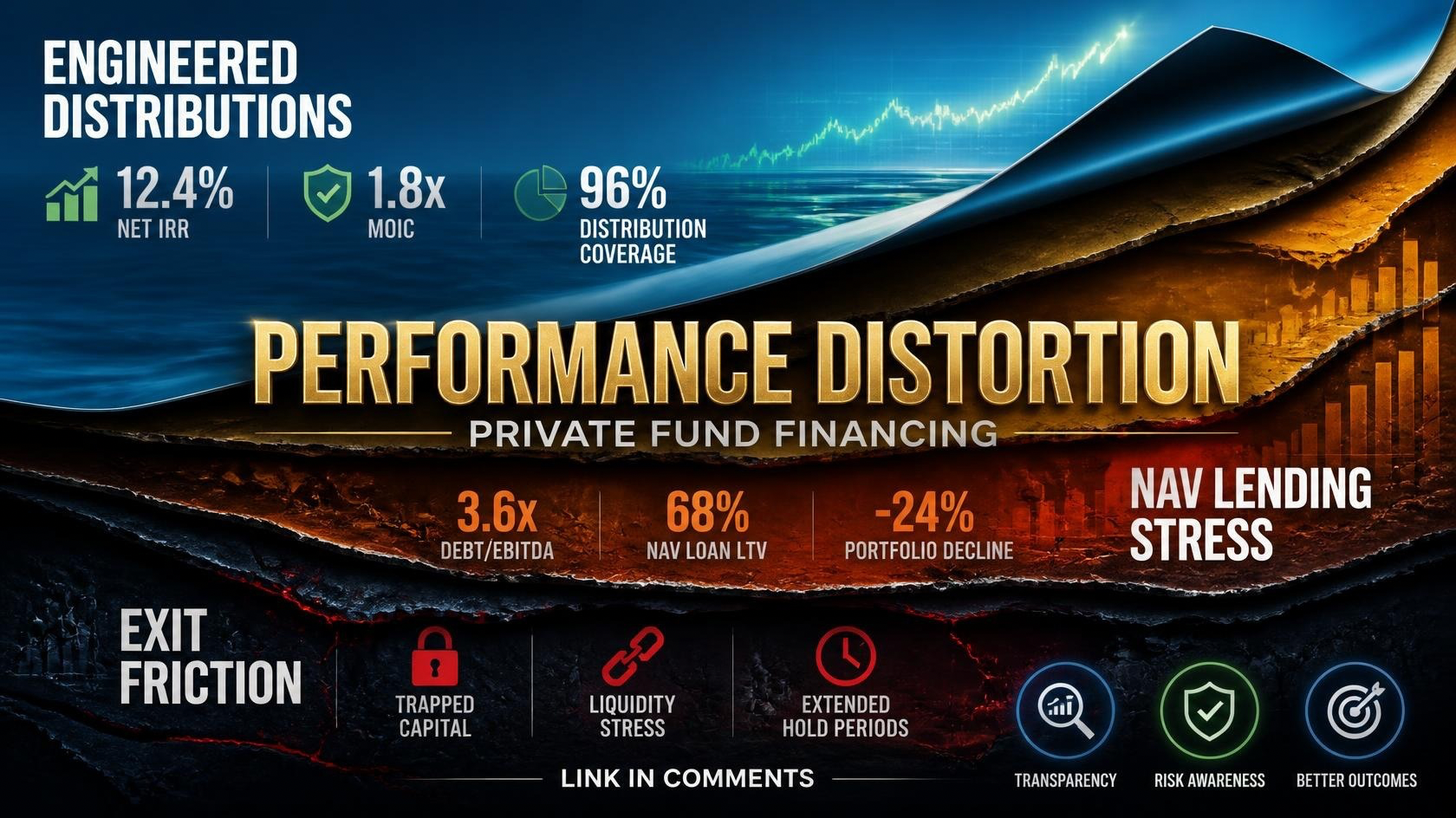
The structural architecture governing private wealth deployment and asset allocation across primary Pan-Asian financial channels is entering a highly deceptive phase of performance tracking as the divergence between reported alternative fund metrics and actual underlying portfolio cash flow profiles reaches an unprecedented peak. This profound systemic distortion is driven by the rapid, widespread expansion of Net Asset Value lending facilities, specialized debt structures secured against a private fund's entire basket of underlying corporate stakes rather than uncalled investor capital commitments. While mainstream wealth management commentary routinely celebrates private equity and alternative managers for maintaining stable asset performance amidst public market volatility, a clinical look-through analysis conducted by sophisticated macro risk architects reveals a far more complex reality. By utilizing fund-level borrowing to force distributions back to wealth intermediaries, general partners are artificially manufacturing an illusion of portfolio liquidity, generating a synthetic liquidity velocity that conceals deep operational friction underneath the corporate wrapper.
The fundamental breakdown in this alternative asset consensus stems from treating engineering and back-end borrowing as permanent substitutes for genuine corporate alpha and natural secondary market realization depth. In a macroeconomic landscape defined by restrictive global interest trajectories and multi-year freezes across initial public offering windows, private fund managers face unprecedented distribution deficits, leaving them entirely unable to deliver natural cash-back realizations to their investor networks. To mask this systemic lack of liquid exits and satisfy the intense pressure emanating from private banking investment committees, general partners are increasingly leveraging the un-crystallized equity layers of their mature portfolio companies to secure massive fund-level credit lines. This financial engineering trick allows managers to return capital to investors on paper, boosting nominal distribution metrics while the actual underlying businesses continue to navigate mounting supply chain overhead and compressed margin realities.
This aggressive reliance on fund-level leverage is creating an immediate operational divide across the regional wealth management matrix, forcing multi-family office fiduciaries and private bank gatekeepers to aggressively stress-test their alternative holdings. Forward-thinking fiduciaries possessing advanced look-through diagnostic tools are executing extensive portfolio reviews, stripping away synthetic liquidity mechanics to evaluate the true, un-levered cash-on-cash performance of external asset managers. Conversely, smaller domestic private wealth houses and boutique advisory desks running fragmented legacy tracking systems remain completely blind to these distortions, continuously allocating capital into over-valued closed-end vehicles based on manipulated historical track records. Because next-generation wealth inheritors and elite asset owners are aggressively prioritizing absolute data transparency and underlying portfolio clarity, fund managers who refuse to provide itemized, un-levered performance metrics face rapid competitive displacement.
Furthermore, this sweeping credit exposure is encountering intense structural resistance from newly codified cross-border regulatory frameworks and look-through accounting overhauls. As global monetary authorities step up their scrutiny of non-bank financial intermediaries and shadow banking concentrations, regional regulators are introducing stringent compliance metrics targeting hidden leverage within alternative asset wrappers. Under these modernized guidelines, internal credit committees are imposing severe balance-sheet capital penalties on corporate wealth containers and family holding companies carrying opaque private credit or private equity assets that lack explicit look-through debt disclosures. This shifting legislative landscape permanently alters the underlying economic calculations for sophisticated regional gatekeepers, driving fiduciaries to clear out high-overhead legacy private equity containers to optimize their aggregate balance-sheet efficiency under newly codified cross-border frameworks, while rotating capital into fully transparent, look-through senior secured alternative credit assets.
An intense consolidation of private wealth capital away from commoditized growth equity fund lines toward highly transparent, cash-generative alternative placements is accelerating across the primary wealth corridors. Multi-family offices and private banks from across the Hong Kong and Singapore hubs will continue to exit stale tech fund pools to secure robust, inflation-protected infrastructure debt originations, maritime logistics financing, and direct hard-asset investments that provide absolute look-through validation. The wealth platforms and subscription news sites that thrive during this cyclical realignment will be those that accept the new reality of absolute structural clarity and optimize their modular delivery engines to parse un-levered asset metrics natively. By accepting the permanent obsolescence of static asset-class boundaries and traditional diversification models, global financial gatekeepers can successfully position their multi-billion-dollar holding containers to withstand systemic macro volatility, guaranteeing true multi-generational wealth preservation across a rapidly evolving global financial landscape.