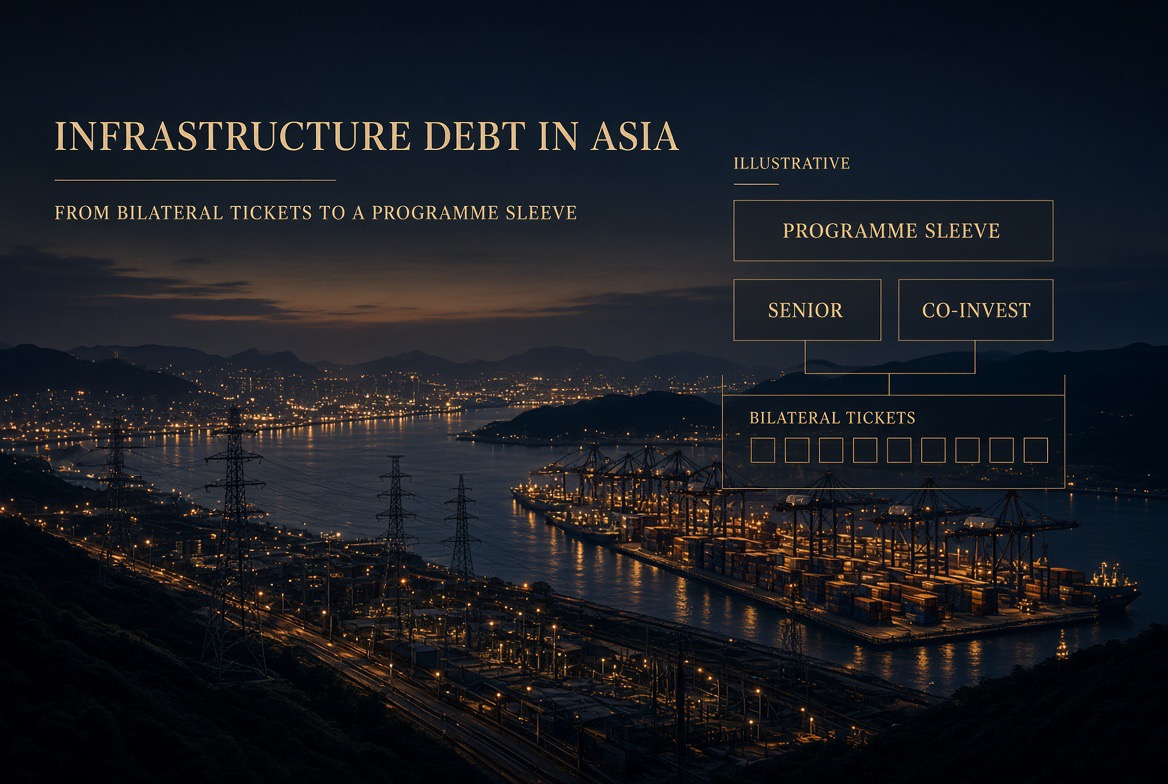
Asia’s infrastructure funding gap is well documented. The Asian Development Bank’s long-standing estimate of $1.7 trillion a year through 2030 remains the reference figure. The constraint facing asset owners is less the existence of projects than the form in which those projects can be held.
Kim-See Lim, chief investment officer of the Asian Infrastructure Investment Bank, said after a joint conference with the Hong Kong Monetary Authority that AIIB is developing a mechanism for insurers, pension funds and other institutions to co-invest in infrastructure debt across 111 member countries on a programmatic basis. The design aim is a common set of terms rather than negotiation deal by deal. From inception through the end of 2025 the bank mobilised about $17.5 billion of private capital, directly and indirectly. Further detail was described as six to nine months away.
“It needs to be done faster and on a greater scale.”
Kim-See Lim, Chief Investment Officer, AIIB, September 2026, following the AIIB-HKMA private-capital conference
The relevance for asset-allocation and institutional desks is the product shape. Large owners generally do not staff a continuous series of bilateral infrastructure-debt closings. They staff sleeves with a defined seniority, a known co-investor, and a calendar that can be taken through committee once. A multilateral platform with standardised documentation is closer to that requirement than a sequence of standalone project tickets.
Fund-level activity in the same complex points in the same direction. Granite Asia raised more than $500 million for a pan-Asia private-credit strategy, with Temasek, Khazanah Nasional and the Indonesia Investment Authority among existing relationships in the platform. Partners Group secured a $1 billion Asia-Pacific private-credit mandate from a major regional institution. CapitaLand Investment has been raising toward a third Asia-Pacific credit programme, targeted at $500 million and focused on senior secured asset-backed investments. Preqin still records Asia at about 4 per cent of the global private-credit market against roughly one-third of world output. APAC-focused private-credit funds raised $2.7 billion in the first quarter of 2026, compared with more than $10 billion for North America-focused vehicles. The allocation interest is visible. The market remains small relative to the underlying economy.
The analytical conclusion is limited. Owners that already run tight alternatives caps, as at GPIF, and owners that have opened double-digit unlisted sleeves, as at NPS, still confront the same operational question: whether infrastructure and senior private credit can be added as a programme with look-through to energy, digital infrastructure and transport, or only as isolated closings. Global owner surveys continue to rank digital and AI infrastructure and energy among priority real-asset themes, in part because data-centre demand is inseparable from power and transmission. That system is more tractable as a sleeve than as a chain of unrelated deals.
For wholesale and institutional coverage, the diligence items that follow are calendar, seniority, co-invest rights and the identity of the capital stack. Those items determine whether a strategy can be held inside an existing alternatives or credit budget. A single project, however well sponsored, does not answer that committee question on its own.