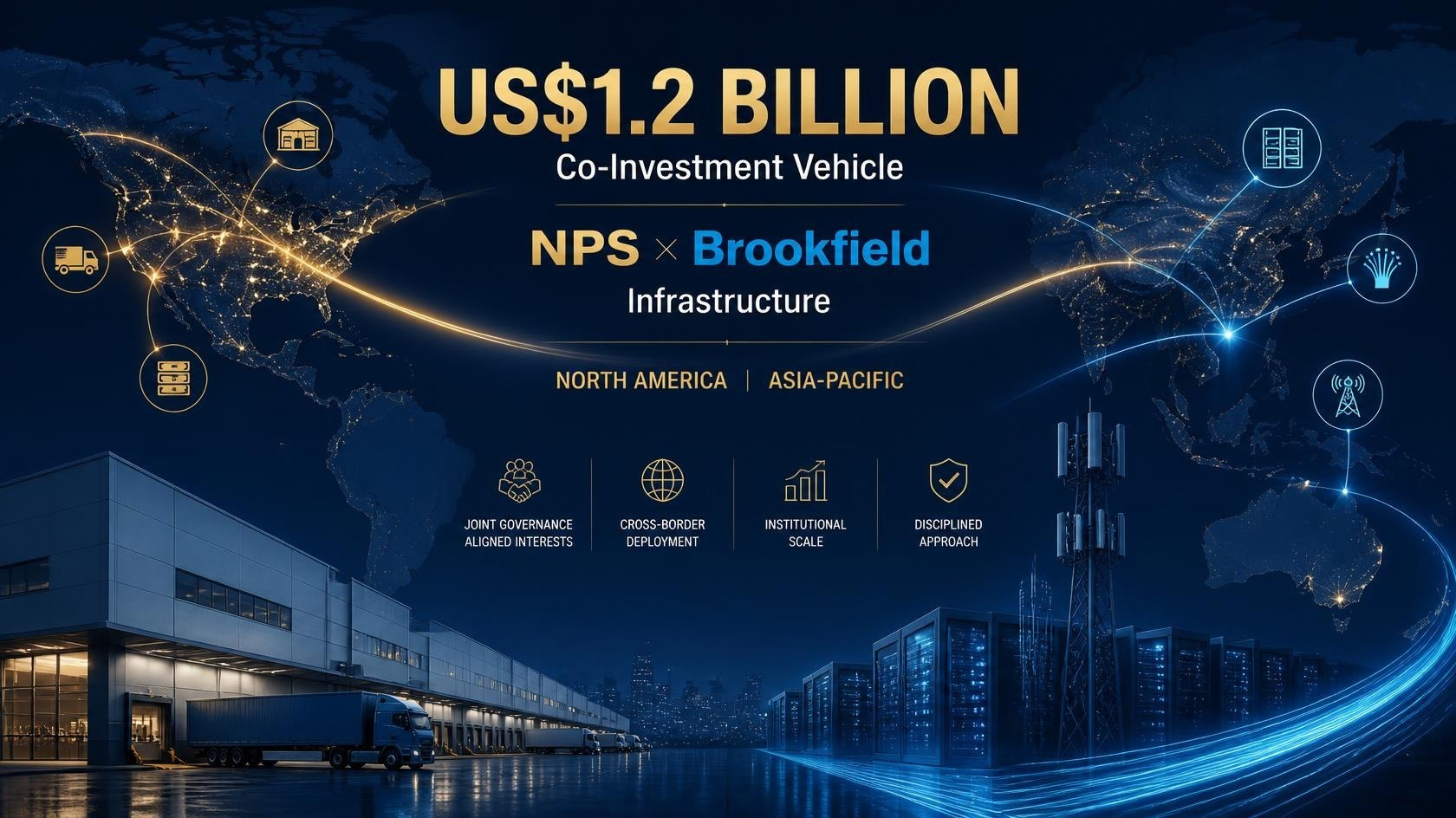
The operational frameworks guiding capital deployment across the primary international real asset corridors are experiencing a significant structural evolution as large-scale public pension boards and state wealth custodians alter their relationship parameters with external fund managers. This high-velocity transformation is perfectly demonstrated by an extraordinary cross-border deployment framework finalized between South Korea’s National Pension Service and global alternative asset giant Brookfield Asset Management today, Wednesday, 2 September 2026. The transaction records confirm that the immense 1.35 trillion-dollar state pension board has committed a massive structural capital tranche to establish a dedicated US$1.2 billion direct co-investment vehicle. Operating under a joint-governance pipeline, this customized asset allocation track is engineered to target prime industrial logistics developments, clean energy distribution nodes, and core digital infrastructure grids across the North American and Pan-Asian trade corridors, bypassing traditional intermediary channels to secure absolute capital insulation.
The core commercial driver behind this aggressive co-investment expansion is the systemic institutional push to optimize net portfolio returns by permanently stripping out redundant intermediary costs. Traditional closed-end fund structures carry a heavy burden of management fees and back-end carried interest layers that create a persistent yield drag on long-duration balance sheets, making it difficult to hit absolute multi-generational wealth preservation targets. By contrast, this structured co-investment framework enables the state retirement pool to deploy capital straight into target physical developments with zero management fees and zero carried interest on the sidecar capital tranche. This highly efficient arrangement drastically lowers the aggregate cost of capital deployment, allowing the asset owner to capture the un-diluted operational cash flows generated by the underlying infrastructure assets.
Furthermore, this direct alignment mechanism provides sophisticated investment committees with an unprecedented level of portfolio customization and factor-risk control that passive fund structures cannot replicate. In a macro landscape defined by rapid technological adaptation and changing global supply chains, relying on a generic, multi-country investment mandate can expose long-duration books to sub-optimal geographic nodes and asset types. Direct co-investment allows the internal real estate and infrastructure teams within the pension fund to execute independent, discrete due diligence on specific physical assets before committing balance-sheet capacity. This highly selective appraisal process ensures that every single dollar deployed serves as an explicit, high-conviction building block within the investor's wider geographic and asset-liability matching strategy.
This direct deployment trend is heavily supported by the massive internal capability expansion occurring within the regional public wealth ecosystem over the past decade. Top-tier pension boards have systematically built out specialized, in-house investment teams staffed with veteran private equity and engineering specialists poached directly from global investment banks and alternative asset management houses. This substantial internal talent bench gives sovereign investors the technical capacity to underwrite complex industrial transactions, negotiate bespoke shareholder covenants, and participate actively in corporate governance boards right alongside the primary general partners. Consequently, the relationship between asset owners and global alternative managers has permanently transitioned from a passive client-vendor dynamic into a highly sophisticated, peer-to-peer origination partnership.
An intense consolidation of institutional capital into customized, direct-investment platforms and separately managed accounts is transforming the global fund management landscape. Asset managers who fail to adapt their distribution models to provide institutional-grade co-investment pipelines and absolute deal-level data transparency face immediate competitive displacement. The investment networks and subscription news sites that thrive during this cyclical realignment will be those that accept the new reality of direct investor empowerment, configuring their platform interfaces to display raw asset-level operational metrics and un-levered cash-on-cash performance histories natively. By accepting the permanent obsolescence of opaque, commingled investment vehicles and building open-architecture origination models, global capital investors can successfully position their multi-billion-dollar portfolios to capture pure alternative premiums, ensuring robust long-term wealth preservation across a rapidly evolving macroeconomic landscape.